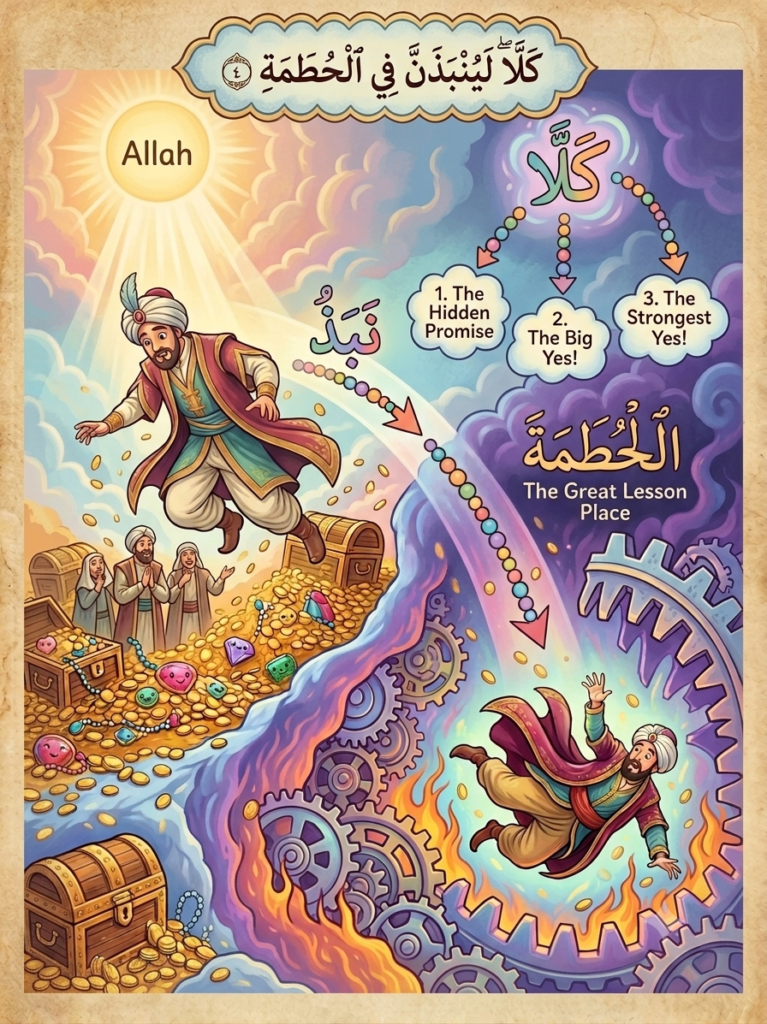
Verse 4 – continued
كَلَّا لَيُنۢبَذَنَّ فِى ٱلْحُطَمَةِ
“No way! He will surely be thrown into the Crusher!” (Verse 4)
What Does “Hutama” Really Mean?
The word Hutama comes from an Arabic root called Al-Hatm, which means to crush, break, or shatter something completely. Originally, this word was used for chewing food, the biting and grinding your teeth do when you eat, not just swallowing. Think about how your teeth completely crush a cracker into tiny pieces before you swallow it. That’s the picture this word paints!
A Story About Ants
This same idea of “crushing” shows up in another part of the Quran, in a story about ants. When Prophet Sulayman (Solomon) and his huge army were marching by, one wise ant warned the others:
“O ants! Go into your homes, so that Sulayman and his army don’t crush you without even realizing it!” (27:18)
Even though Sulayman’s army was massive and powerful, this verse imagines what would happen to something as small and fragile as an ant if it got in the way, completely crushed underfoot. That’s how strong this word “crush” really is.
A Story About Dry Grass
The same root word shows up again in Surah Al-Hadeed, this time talking about plants:
“Like rain that makes plants grow, which delights the farmer. Then the plants dry up, turn yellow, and crumble into tiny broken pieces.” (57:20)
Here, the word paints a picture of something green and full of life… that eventually dries out and crumbles into dust. It’s the same feeling of being broken down into nothing.
Hutama Can Also Mean “Someone Who Eats Too Much”
Interestingly, this word can also describe a person who is extremely greedy and eats way more than they need, because of how much they consume! That’s part of why this word was chosen for a type of Fire in Hell: because that Fire is imagined to be “hungry,” consuming everything in its path, never getting full.
Why This Was a Brand-New Way to Describe Fire
Here’s something really interesting: before the Quran, Arabs didn’t usually describe fire as something that “crushes.” They talked about fire burning things, but not crushing them. This is actually the very first time in the Arabic language that “Hutama” was used to describe fire! By choosing this word, the Quran is describing a fire so powerful that it doesn’t just burn, it pulverizes, like a giant crushing machine, breaking everything down into nothing.
The way this word is built in Arabic also tells us something important. It uses the same pattern as “Humaza” and “Lumaza” (the words from Verse 1, remember?) a pattern that means something isn’t just a one-time thing, but a habit, something that keeps happening over and over. So this fire doesn’t just crush once, crushing is simply what it always does.
Why This Exact Word? Three Big Reasons
A wise Islamic scholar named Imam Fakhr al-Din al-Razi explained why the Quran picked this exact word, “Hutama,” for this punishment. Here are his three reasons, explained simply:
- It Matches the Crime. Remember how “Humaza” means someone who crushes others with mean words and mocking? Well, “Hutama” means they will be crushed right back! It’s like the Surah is saying: “If you spent your life crushing other people’s feelings, then here is something that will crush you.”
- Breaking Matches Breaking. The word “Humaza” also has a hidden meaning of “breaking” like breaking someone’s reputation or breaking their good name by saying mean things about them. “Hutama” means breaking too, but in an even bigger way — not just breaking someone’s feelings a little bit, but crushing everything completely, with nothing left over.
- The “Eating” Connection. There’s a verse in Surah Al-Hujurat (49:12) that compares backbiting — saying mean things about someone behind their back, to eating that person’s flesh! Since gossipers “eat” other people’s reputations with their words, they are sent to a Fire that is described as “hungry” too, one that consumes and devours completely.
The Big Lesson
In every one of these explanations, there’s one powerful idea: the punishment matches the sin. People who spent their lives “consuming” other people’s honor and dignity through gossip and mockery will one day be “consumed” themselves. It’s a mirror, whatever you send out into the world has a way of coming back to you.
Discussion: Exploring Big Ideas Together
- The Cracker Question: Now that you know “Hutama” originally meant crushing food with your teeth, does that change how powerful the word feels to you?
- The Ant Question: Why do you think the Quran uses something as tiny as an ant to help us understand the word “crush”?
- The Mirror Question: The scholar Al-Razi said the punishment “mirrors” the sin. Can you think of another example — in real life or in a story — where what someone did came back to them in a similar way?
This post is part of our ongoing series on Surah Al-Humazah (Surah 104) for kids. Read our previous posts on Verse 1, Verse 2, Verse 3, and Verse 4 to follow along from the beginning!